Species - Thraupidae
The family Thraupidae, better known as the tanagers, is one of the most colorful and diverse groups of birds in the New World. This family was first described in 1847 by the German ornithologist Jean Cabanis, with the genus Thraupis as its reference point. Since then, our understanding of these birds has evolved considerably.
Originally, tanagers were classified based on their physical characteristics and feeding behavior. Nectar-feeding species were grouped with honeycreepers, seed-eaters with finches or cardinals, and fruit-eaters within the tanagers themselves. While this classification seemed logical, it later proved not to accurately reflect the true evolutionary relationships between species.
With the rise of modern DNA and phylogenetic studies in the late 20th century, it became clear that many of these traditional groupings were incorrect. Several genera once considered tanagers, such as Euphonia and Chlorophonia, were found to be more closely related to finches and are now placed in the family Fringillidae. Others, such as Piranga, are now classified within the family Cardinalidae. These taxonomic revisions have been formally recognized by organizations such as the American Ornithological Society.
Today, Thraupidae is considered part of a larger group of New World passerines, comprising more than 800 species. Within the tanagers themselves, there is an extraordinary diversity of forms and lifestyles: from brightly colored fruit-eaters to seed-eaters with strong bills, and from slender nectar-feeders to active insect hunters. This diversity makes the family particularly fascinating for both scientists and bird enthusiasts.
Due to the many taxonomic changes, common names do not always align with scientific classification. Some birds still carry the name “tanager” even though they no longer belong to Thraupidae, while others within the family are called “finches” despite not being true finches.
Further research has shown that the internal classification of the family is also complex. Molecular studies have led to the revision of several genera: some have been split, others merged or reinstated. This ongoing process continues to refine our understanding of the evolutionary history of these birds.
At present, the family Thraupidae includes nearly 400 species, spread across numerous genera and subfamilies. As such, tanagers represent one of the largest and most diverse bird groups in the tropical regions of Central and South America.
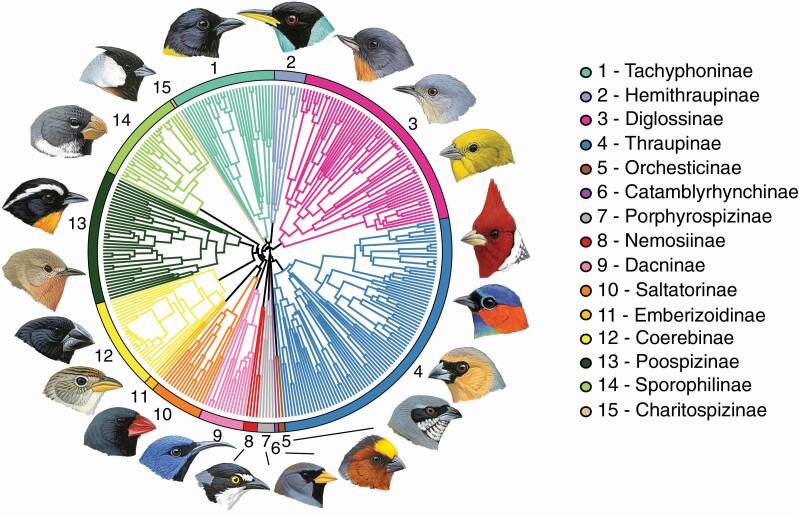
© https://avianhybrids.wordpress.com/2022/11/09/slow-down-please-the-evolution-of-beak-morphology-in-tanagers/
For each species on this website, a concise overview is provided of the main characteristics, such as appearance, distribution, habitat, and behavior. Where possible, additional information is included to help better understand the species and distinguish it from related species.
The aspects of diet and breeding are intentionally not discussed in detail for every individual species. These are largely similar across many tanagers and are therefore covered separately on the general pages about nutrition and breeding. Only when a species has clearly different requirements, or when specific experiences are available (for example in a breeding report), will this be mentioned separately.
In this way, each species account remains clear and easy to read, while still including all relevant and distinctive information.
Visitors are also warmly encouraged to share their own experiences. Practical knowledge from enthusiasts and breeders is highly valuable and can help to further enrich and refine our understanding of these species.